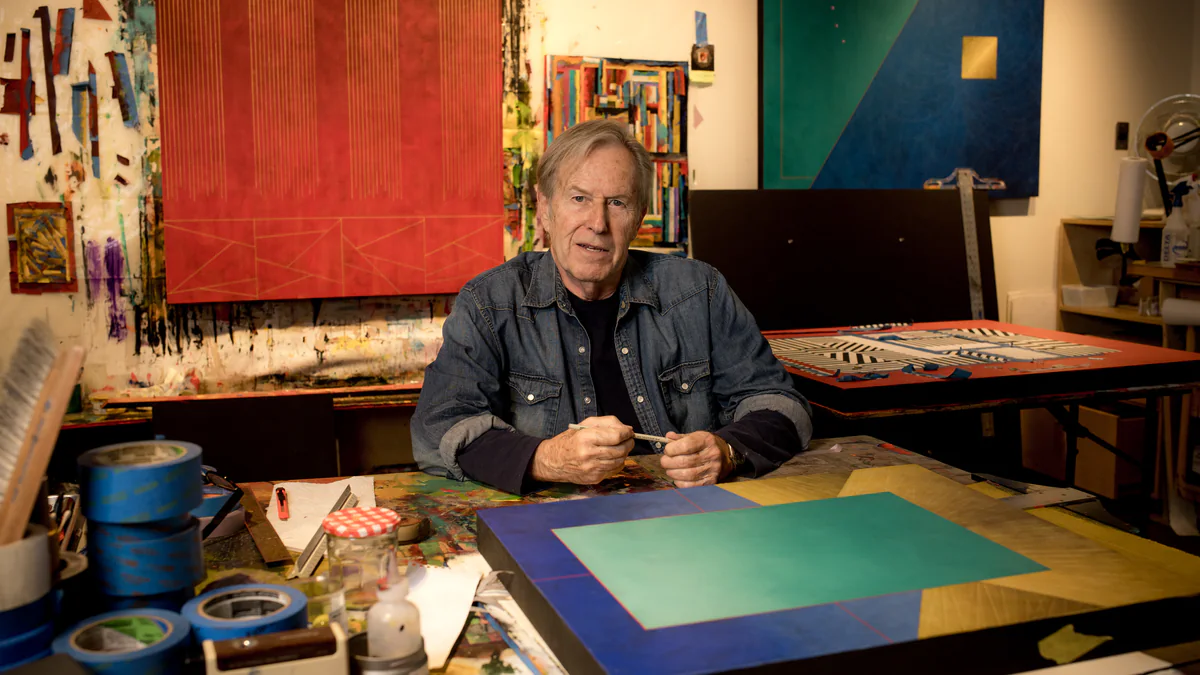
Richard Carter on learning from Herbert Bayer, helping shape Aspen’s cultural landscape and remaining curious after more than five decades as an artist.
Interview by Bryan Welker and Stefan le Roux | For The Aspen Times
When Richard Carter arrived in Aspen in 1971, the town had few sidewalks, no traffic lights, empty lots and the occasional burned-out car. To a young artist leaving the East Coast, it was “fantastic.”
Carter went on to work as Herbert Bayer’s studio assistant, help establish the organization that became the Aspen Art Museum, and play a founding role at The Arts Campus at Willits. These days he continues to focus less on repeating past successes and more on what comes next.
Bryan: What brought you to Aspen?
Richard: I grew up in New Jersey and went to Villanova. A couple of friends moved out here, so we came for a vacation in April of 1971. It was fantastic.
We went back East. My wife was a designer in New York, and I had a studio in Weehawken. I came home one day, and she said, “I gave notice on the apartment, I quit my job, and we’re moving to Aspen.” Two weeks later, we moved everything out.
Bryan: How have you sustained a career as an artist here?
Richard: Most artists, unless they come from wealth or are married to someone who does, need another job.
I worked as a production designer in movies for 35 years, mostly doing commercials. I would work for a few weeks, then have that amount of time off again. I never suffered for studio time, but I got health insurance, a pension, and a good income.
Bryan: You spent seven or eight years working for Herbert Bayer. How did that happen?
Richard: I had been working construction for about a year. On a rainy day, I ran into a writer from a local paper who said, “You’re a painter. You should talk to Herbert Bayer. His painting assistant is gone.” First, I had to go to the library and ask, “Who is Herbert Bayer?”
I was nervous because I had no formal education, but he hired me. I learned certain techniques and his color theory, but the biggest lesson was the practice of getting up every day and going to work.
Bryan: How did your involvement in the Aspen Art Museum begin?
Richard: I drove past the old powerhouse every day on my way to Bayer’s studio and wondered what we could do with it. Then the city bought the powerhouse, the Wheeler and the old hospital, and asked citizens’ groups what to do with them.
A light bulb went off: There should be a museum.
I got some other artists together, and we went through three years of planning, designing, and hiring.
The city eventually gave us the building and paid for the renovation. It was called the Aspen Center for the Visual Arts then, and it became the Aspen Art Museum. Later, I became involved with Anderson Ranch and helped found TACAW. It has been a great trip.
Bryan: How has Aspen’s changing economy affected its creative community?
Richard: It’s not like it used to be. I don’t have studio assistants anymore; they had to move. I had an incredibly talented carpenter I’ve worked with for years who had to leave because he couldn’t afford it here anymore.
Bryan: Your work covers a wide range of subject matter. Where does that come from?
Richard: I’ve been doing it a long time, and I do a lot of different things. A lot of artists are recognizable from day one until they are 90 years old. I’m not like that.
I recently finished a series where I blew up classic Japanese woodblock prints much bigger than their original size, redrew them in pencil, and inserted a little red bunker into the image.
I started drawing it during COVID, when people were stuck in their bunkers.
That series will have a show in Denver in November and at The Art Base next year.
Bryan: Where did your interest in Japanese art come from?
John Powers, whom I considered a mentor, got me interested in Japanese art in the 1970s. I’ve been to Japan myself, and I have a nice collection of Japanese art.
Bryan: Any advice for a young artist?
Richard: Do what you want to do, but do what you have to do.
Bryan: What are you working on now?
Richard: I have moved on to a series based on string theory, which is something in physics that nobody understands. I don’t understand it, but it is a great title. I’m still appropriating Japanese prints, but instead of a bunker, the figures might be making a cat’s cradle with their hands. I’ve taken the color to an absurd level.
Bryan: How do you stay inspired?
When I don’t know what to do next, I do something, and eventually it flows.
More than 55 years after arriving in the valley, Carter is still following that instinct. His legacy can be found in the institutions he helped establish and in his concern for the conditions that allow creative lives to take shape.
Now, from his studio in Basalt, the work itself continues through the daily discipline Bayer impressed upon him: show up and remain open to where it leads.
Carter is represented by Hexton Gallery, Aspen.
Bryan Welker lives and breathes business and marketing in the Roaring Fork Valley and beyond. He is President, Co-founder, and CRO of WDR Aspen, a boutique marketing agency that develops tailored marketing solutions. Who should we interview next? Reach out and let us know bryan@wdraspen.com