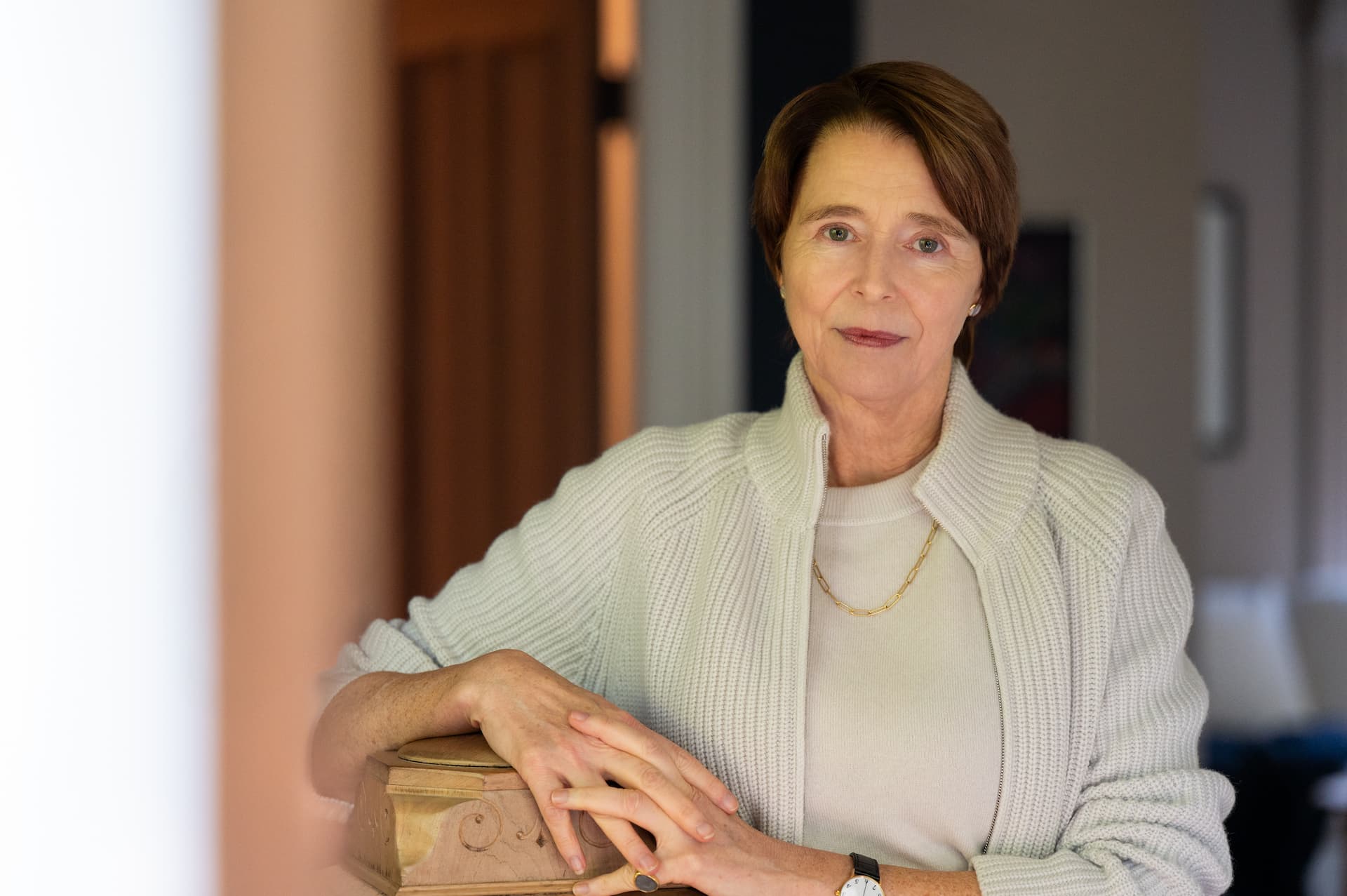
Ophelia Dahl, co-founder of Partners In Health, on the complexity of equitable health care.
Interview by Bryan Welker and Stefan le Roux | For The Aspen Times
The daughter of author Roald Dahl and actress Patricia Neal, Ophelia Dahl grew up around creativity, resilience, and a practical belief that difficult problems could be met with imagination and persistence.
As co-founder of Partners In Health, Dahl has spent more than four decades helping build healthcare systems in countries such as Haiti, Rwanda, and Malawi. The work is not simply about providing aid in moments of need, but about building the clinics, supply chains, training programs, partnerships, and public systems that allow care to endure.
We spoke with Dahl about what shaped her thinking, what the work demands, why global health resists simple answers, and what it means to stay with a problem long enough for change to take root.
Bryan: Your parents were both remarkable figures in very different ways. What do you think you inherited from them, and how did that shape your path?
Ophelia:
I think it’s hard to separate what you inherit from what you absorb just by being around people. I suspect I was socialized, in a way, to believe that solutions were possible.
My father was always trying to fix things. Sometimes it was something small in the garden, or some new way of making a hose pipe work better, or a different kind of mailbox. But that instinct was there in more serious ways too. If someone called him from across the world because a child had been affected by something, he would really be affected by that. He would chew on it. He would think about what could be done.
That kind of pragmatic, solutions-based approach seeps into you over time. You don’t necessarily recognize it while you’re growing up, but later you realize it was part of the atmosphere around you.
And my mother’s courage is something I came to understand more fully only as I got older. She had her stroke when she was 39, very young in her career, and as a teenager I didn’t fully grasp what that meant. I didn’t understand how abruptly it had changed the course of her life, or the discipline it took to relearn, rebuild, and return to her work.
Later, after seeing patients in places without even basic care, I recognized both the scale of her recovery and the privilege of having access to systems that make that recovery possible. My mother had access to medical systems and rehabilitation. Many of the people I’ve met through this work do not.
So when I went to Haiti, it genuinely didn’t occur to me that we couldn’t do something to change the situation. I don’t mean that arrogantly. It was more that if something was wrong, of course you tried to do something about it.
Bryan: You’ve seen firsthand some of the most difficult realities of the human condition. How do you cope with that exposure?
Ophelia:
Nothing really prepares you for it, especially when you start young.
One of the most important things is that you don’t do it alone. Doing difficult work with people you trust, people you respect, and people you can laugh with makes an enormous difference. Humor matters.
Paul Farmer always encouraged us to get as close to the work as possible. Not in a performative way, but because proximity changes your understanding. There are moments when you want to turn away. You see things and think, “I wish I could unsee that.” Paul and I used to joke that we didn’t have a control-alt-delete button in our heads.
But at the same time, you recognize that what you are witnessing is someone else’s daily reality. I could leave. I could step away from a situation. The people living through it could not. That difference matters.
If you are not close enough to the work at certain times, you become less effective at communicating it. And part of the work is keeping people connected to realities they may never see firsthand, in places they may never visit.
So there is a balance. You need enough proximity to remain honest about what is happening, and enough distance to sustain yourself. You have to be immersed enough to understand the work, but you also have to step back at times so that you can continue.
There’s a phrase I’ve always thought about: mercy is being immersed in the chaos of other people’s lives. That feels close to what this work asks of you.
Bryan: Can you define health equity?
Ophelia:
It is a problem that resists simple definitions, but fundamentally it is about making sure access to care is not determined by geography, poverty, or circumstance.
It starts from a different premise than many health systems do. It is not about asking what the bare minimum requirement is. It is about asking what is required for people to have a fair chance at living healthy and fulfilling lives.
That means recognising that people are not starting from the same place. Some communities already have hospitals, doctors, insurance systems, ambulances, supply chains, and infrastructure. Others may not have even the most basic entry points into care.
So equity is not about giving everyone the same thing. It is about responding to the gap. It is about making sure that those with the least access receive the greatest level of attention, investment, and support so that, over time, the imbalance can be corrected.
At Partners In Health, we have often spoken about the idea of a preferential option for the poor. That phrase can be difficult for people at first. Someone might say, “Well, if my aunt in Canada needs medical care, she needs it just as much as someone in Malawi.” And of course she does. But the difference is that your aunt in Canada already has access to a system. The person in Malawi may not.
That is where the preferential piece comes in. It is not about saying one life matters more than another. It is about recognising where the burden is greatest and where the system is weakest, and then putting more attention there.
For us, health equity means working to ensure that people, regardless of where they live, have access to the fruits of modern medicine. And that requires doing whatever is necessary to build the systems that make care possible: training clinicians, strengthening supply chains, working with governments, addressing food, water, transportation, and the social conditions that shape health in the first place.
That’s an incredibly long definition, but if Partners In Health had a perfect elevator speech, we would probably be failing to embrace the complexity of what we are trying to do.
Bryan: What is the biggest hurdle in achieving global health equity?
Ophelia:
One of the biggest hurdles is keeping people interested.
That might sound simple, but it is true. People who have access to much fuller systems can find it difficult to stay engaged with the realities of places that do not. There is also a very human tendency to want quick solutions.
People will ask, “What can we do?” And when you explain what is required, they often look for one piece of the problem they can isolate. They might say, “What if we funded a thousand trees?” or “What if we funded twenty wells?” And of course, those things can matter. But they do not exist in isolation.
If you dig a well, you also need systems to maintain it. If you provide medicine, you need to make sure people have food. If you build a clinic, you need trained staff, supply chains, infrastructure, and governance. If children are healthy, they need schools. If they are educated, they need pathways to employment.
It becomes complex very quickly.
There’s a children’s book, If You Give a Moose a Muffin, and sometimes it feels a little like that. Each intervention reveals the next need, and then the next. Not because something has gone wrong, but because that is how systems function.
We like simplicity, but life is complex. Life for people living in poverty is even more complex. So the work cannot be about solving one visible piece and declaring victory. You are trying to build something that can hold together long after you have stepped away.
That requires time. It requires patience. It requires people to remain interested even when the results are not immediate or easily attributable to a single action.
Bryan: After more than four decades in this work, has your perspective changed?
Ophelia:
I think what has changed is my tolerance for complexity. Perhaps even my appreciation of it.
Early on, you are trying to solve problems as you encounter them. Over time, you begin to understand how interconnected everything is. You start to see patterns, but you also see how resistant those patterns are to simple solutions.
There is a tendency to look for clarity, for something that can be easily explained. But the more time you spend in this work, the more you realize that anything that feels too simple probably is not addressing the full picture.
And I have come to feel that if something is too easy to fix, it may mean we have not really gotten our hands dirty enough. We may not be creating a solution that is durable enough to hold.
The work is not linear. It is four steps forward, many steps back, sideways, and then forward again. That is just the nature of trying to build something real.
Bryan: Have you seen that long-term approach play out in a way that captures what is possible?
Ophelia:
Yes. There is one story I often come back to.
In Cange, in central Haiti, where we first started working hand in hand with the community, there was a young woman who came to the clinic. She had a fever and had fainted, and Paul suspected malaria. She did have malaria, and while she was being treated, they discovered that she was pregnant.
If she had gone untreated, especially with cerebral malaria, it could have been catastrophic for her and for the baby. But because there was a clinic, she received care. Because there was a system around that clinic, she then had access to maternal care and was able to have a safe delivery.
Her child had access to vaccinations. He had access to food. He went to elementary school, then high school. His parents had work in and around Cange. One may have been a community health worker, another may have worked in procurement. These were the kinds of things that grew from the platform of primary care.
The boy’s name is Bobby. His parents had lived in a mud hut, in deep poverty, but through that foundation of care and the systems surrounding it, Bobby grew up, went to medical school in Port-au-Prince, and came back to Cange.
By then, there was a hospital in central Haiti, built after the earthquake, and a residency program supported by the government and clinical partners. Bobby became a resident, then a chief resident. Now he is working in Haiti and helping train other physicians.
I remember him as a baby. I have a picture somewhere from around 1985 of Paul weighing Bobby on scales I had brought from the UK so we could begin to understand levels of malnutrition.
When I look at that picture and think about Bobby now, I think that is what it means to accompany someone. It is not a single intervention. It is a long arc of care, education, work, training, and return. He is now part of the system that supports others.
That is the work. It does not happen quickly, and it does not happen in isolation. But over time, it compounds.
Bryan: Considering the complexity of the problems you face, how do you stay grounded?
Ophelia:
For me, it is quite practical.
Exercise is important, not just physically, but because it creates space for thinking. It is one of the few times when your mind is not being pulled in a hundred directions. Whether it is walking, running, hiking, Pilates, or yoga, that is often when things begin to settle.
Reading does something similar. It allows ideas to sift and connect in ways that do not happen when you are constantly reacting.
Family and friends matter enormously. I like to cook. I like to gather people. Those things are therapeutic and grounding. They bring you back to something human and immediate.
I also think I was fortunate in how I grew up. My childhood was more grounded than people might assume. We grew up in rural Great Missenden. My father worked in a hut in the garden. My mother worked mostly in the United States, but we did not go there very much. We knew what they did, but it did not occur to us that they were anything particularly special, apart from being exceptional parents.
So I think I started from a fairly grounded place. Curiosity helped too. My parents were curious and interested in other people, and that also shaped me.
Bryan: What gives you optimism about the future of global health?
Ophelia:
One of the things that excites me most is the next generation.
The University of Global Health Equity in Rwanda is a big part of that. Partners In Health worked with the Rwandan government, the Ministry of Health, and the Ministry of Education to build it in northern Rwanda. It is not just a medical school. It is designed to train people across the broad field of health equity and everything it takes to build strong systems.
That includes clinicians, of course, but also people working in policy, procurement, supply chains, information technology, and other areas that are essential to making healthcare function. There is already work happening around AI and many partnerships with universities around the world.
Students come from different countries in sub-Saharan Africa and beyond. Many already have experience in government or public systems. They come into the program, learn with others, and then return to their own countries with tools they can adapt to their own contexts.
That is exciting because the future cannot be about creating dependency on organisations like ours. It has to be about building systems that can stand on their own, led by people who understand the places they are serving.
That was enormously exciting to Paul. He saw it as part of the future of the work. And I do too.
There is a temptation to compartmentalize complex, global problems into bite-sized solutions that feel manageable but often fail to address the bigger picture.
What becomes clear through Ophelia Dahl’s work is that real progress demands the opposite: a willingness to engage with complexity head-on, to resist the instinct to simplify it too quickly, and to remember that the potential for positive change is not in question—only our willingness to stay with the work long enough to make it sustainable.
Bryan Welker lives and breathes business and marketing in the Roaring Fork Valley and beyond. He is President, Co-founder, and CRO of WDR Aspen, a boutique marketing agency that develops tailored marketing solutions. Who should we interview next? Reach out and let us know bryan@wdraspen.com