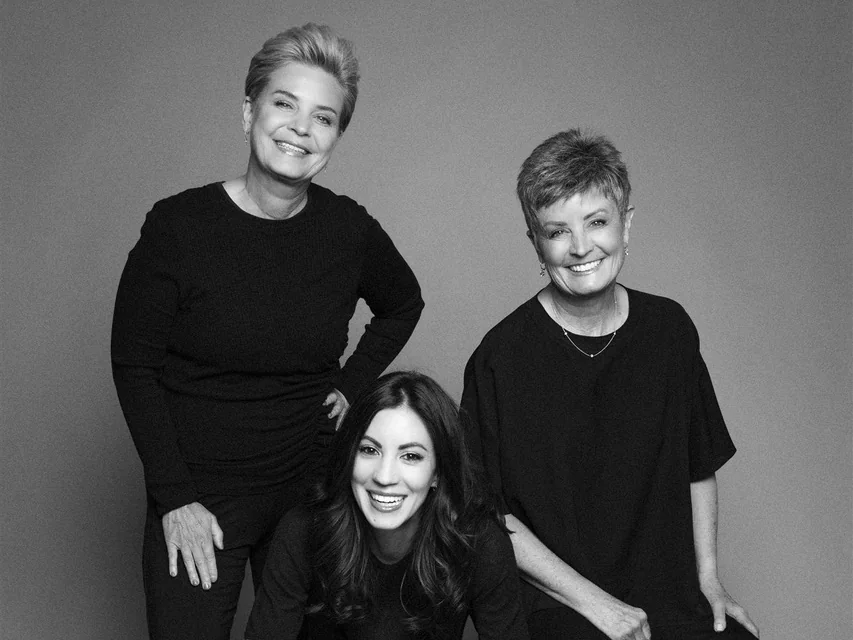
Nicole and Noelle Hernandez on building—and carrying forward—a family design business shaped by an obsession with how people actually live.
Interview by Bryan Welker and Stefan le Roux | For The Aspen Times
There are plenty of ways to describe Aspen’s design world: polished, expensive, exacting. But at Matter Planning + Design, the firm founded by Noelle Hernandez and now carried forward with her daughter Nicole, the work has always been more intimate than that. It is less about creating monuments and more about creating homes that function at the level of real life—how a family cooks, where a couple drops their keys, even where someone reaches for socks in the morning.
In this conversation, Bryan speaks with Noelle and Nicole Hernandez about what it takes to build a lasting design business in Aspen.
Bryan: We like to start every interview the same way: “How did you get to Aspen, Noelle?”
Noelle: I was born and raised in Denver and was designing for my father-in-law’s kitchen manufacturing company there. When they sold the business, my husband and I had an opportunity to make a change. We looked around at different places, and eventually came up to Aspen and rented a little house on Cemetery Lane. I told my husband, “Give it a year.”
The next thing I knew, I was on boards—the museum board, the Country Day board. After a year, I felt there really was a community here worth staying for and raising our kids in. That one-year experiment turned into 38 years.
Bryan: How did the experiment turn into a business?
Noelle: When we first moved here, I was mostly a full-time mom, and I was happy doing that. Then Aspen Country Day decided to build a new building, and I volunteered to be on the committee. It started as a committee of ten and turned into a committee of one. I interviewed contractors, hired the architects, and helped accomplish County Day’s vision under schedule and under budget.
After that, someone asked if I would help with a private development. I said yes, but I was only supposed to help keep the project moving, but I could not help myself. I would walk in and say, “That door swings awkwardly,” or “Those light switches are too far from the bed.” I just naturally started solving problems.
Before Aspen, while designing kitchens, I was already learning the construction side by asking questions constantly—how something was wired, why a plumber did it that way, what a soffit was. I was basically giving myself a construction education. Once I got here, one project led to another, and it grew by word of mouth.
Then people started asking me to do furniture, which I initially resisted. But eventually I did, and later, when Nicole moved back from California, I told her, “You do the furniture so I can stay focused on construction,” because that is what I love most.
Later, my sister Soraya joined us as well, and the business evolved into the three of us working together in different ways. But it all started with loving the work and never really learning how to say no.
Bryan: Aspen can be a hard town to build a lasting business in. Why do you think you’ve been able to do it for so long?
Noelle: A lot of it comes back to giving people your whole heart. I love doing the work, and I respond quickly. That is something clients always noticed. If they have a question on a blueprint, a budget, or a decision, they are not waiting three weeks for a response. They got an answer that day or the next day.
Over time, that built trust. I was always very transparent about budget, and I often acted almost like an owner’s rep—thinking about the client’s best interest with the contractor, the architect, and everyone else involved.
I have also personally renovated 12 homes, so I understand how emotional the process is. It is not just about money. It is about expectations, stress, couples making decisions together, and the fact that a home is deeply personal. I used to joke that I should add “construction therapy” to the back of my card, because sometimes you are helping a husband with the budget and a wife with what she wants, and trying to get them both through the process.
Most importantly, I never want a client’s house to feel like a monument to Matter. I want it to feel like their home, with personal details that are true to them. We always tell clients that by the time we are done, we know where their underwear goes. We know how they live. We have curated the placement of their art collection. That is the level of detail we care about, because if we do our job right, the house fits the client—not the other way around.
Nicole: My mom has done such a good job of building trust because she has always operated with honesty and integrity. She is transparent about budget, she advocates for the client, and she thinks like an owner. Our team meticulously designs for the lifestyles, routines, needs, and preferences of our clients to deliver an enhanced living experience. That has become a huge part of our reputation.
Bryan: What has this career—and this town—given you?
Noelle: A lot of joy and a lot of creativity. I love being busy. I love giving back and participating in the community. I deeply appreciate how much Aspen values art and design, and dynamic lifestyles. And the real reward is the end result of a project—when someone is in their home, and they call you to say, “We love this,” or “I forgot about that detail, and now I use it every day.” That feels good. It means we took the time to really understand how our clients live, listened to their wishlist, and improved their everyday lives.
Bryan: You’ve been through 9/11, the 2008 financial crisis, and COVID. How did the business survive those big shifts?
Noelle: Each one was different. After 9/11, there was a lot of fear, but people also wanted smaller communities and more security. Aspen still appealed to them. During COVID, once the initial shutdown passed, things became completely wild. People were rushing out of cities and into towns like this. We got very busy, very fast. The industry as a whole experienced a surge.
What changed was the pace. Pre-COVID, many of our clients were long-time locals and Aspen families with shared history and deep knowledge of the community. During COVID, many new people moved to town, bringing a fresh perspective, but often with expectations based on the large markets where they moved from. In that time of transition, we had to be disciplined. We did not want to take every job just because it was available. While we evolved the company, we stayed true to our process, our quality, and our values.
Nicole: I would add that post-COVID, families started thinking differently about how they live. A lot of homes became more multi-generational. Adult children moved in, grandkids were around more, people were working from home full-time, and clients were thinking about design through the lens of how a whole family spends more time together. That changed the way we approached space planning. There were more multi-use demands on spaces and homes.
Bryan: What is it like working together as mother and daughter?
Noelle: I feel blessed. Truly. We were just talking about it this morning. How lucky am I to work with my daughter and my sister—people I trust completely? If one of us needs to step away, someone else can carry it. That kind of trust is invaluable.
Nicole: It really is the best part. I am so proud to carry this business forward, but the best part has been working together. We can finish each other’s sentences. We problem-solve together all the time. I have learned everything from my mom—the nuts and bolts of how the business runs, how we order, how we bill, how our process works—but more than that, I have learned how to show up.
The biggest lessons have been about hard conversations, setting expectations, and maintaining integrity. Construction can be emotional. Remodeling, especially, is a Pandora’s box.
Sometimes you open a wall and find surprises. Sometimes clients are upset, and rightly so. I have learned from my mom how to sit with that, be honest, not take it personally, and help bring the joy back into the process.
That is something I carry with me well beyond work.
Bryan: What advice would you give to a young entrepreneur trying to make it in Aspen?
Noelle: Patience. Thick skin. And stay true to yourself. This town can be intimidating. You have to remember what you bring to the table. You have to know your value.
Also, do not confuse appearances with substance. We built this business with very low overhead. For years, we worked out of my house. We did not need shiny bells and whistles to prove who we were. We trusted the quality of our work and the quality of our service.
Nicole: I would add community. Take the time to network. Meet people. Be involved. Give back. That matters here. In Aspen, people remember how you show up.
Bryan: What have you learned about doing business here over the long run?
Noelle: Relationships are everything. We have electricians, plumbers, carpenters, roofers, window people—some of them we have worked with for decades. In some cases, I worked with the father, and now I work with the sons. That is one of the gifts of staying in a place long enough: you build a real team.
To serve clients well, you need tradespeople who care as much about the work as you do. We have been lucky to build that over time. It is not about shutting new people out. We always stay open. But the people who last are the ones who work hard, communicate honestly, and take pride in what they do.
Bryan: One last thing, how did you come up with the name Matter?
Nicole: Originally, the company was called NCH Design. Later, when we brought our worlds together more formally, we worked with a consulting agency and went through a full strategy process to figure out a new name. We wanted something that reflected how we think about projects.
Matter stood out because it works in so many ways. It is a noun and a verb. It speaks to materials, to importance, to process. And most of all, it reflects how we work: every detail matters to us. Every decision matters. Every client matters. We think carefully about how people live, because we want the experience of the home to feel seamless and to genuinely enhance their lives.
That is really the heart of it.
In a place where image can sometimes get ahead of substance, Matter’s story feels refreshingly grounded. The firm’s success has not come from spectacle, but from consistency: exacting quality, quick responses, hard-won trust, deep local relationships, and a willingness to care about the smallest details because they shape the way a life is lived.
For Nicole Hernandez, carrying that legacy forward is not just about preserving a business. It is about preserving a way of working—one built on discretion, integrity, and the belief that good design begins by paying close attention to what matters most.
Bryan Welker lives and breathes business and marketing in the Roaring Fork Valley and beyond. He is President, Co-founder, and CRO of WDR Aspen, a boutique marketing agency that develops tailored marketing solutions. Who should we interview next? Reach out and let us know bryan@wdraspen.com