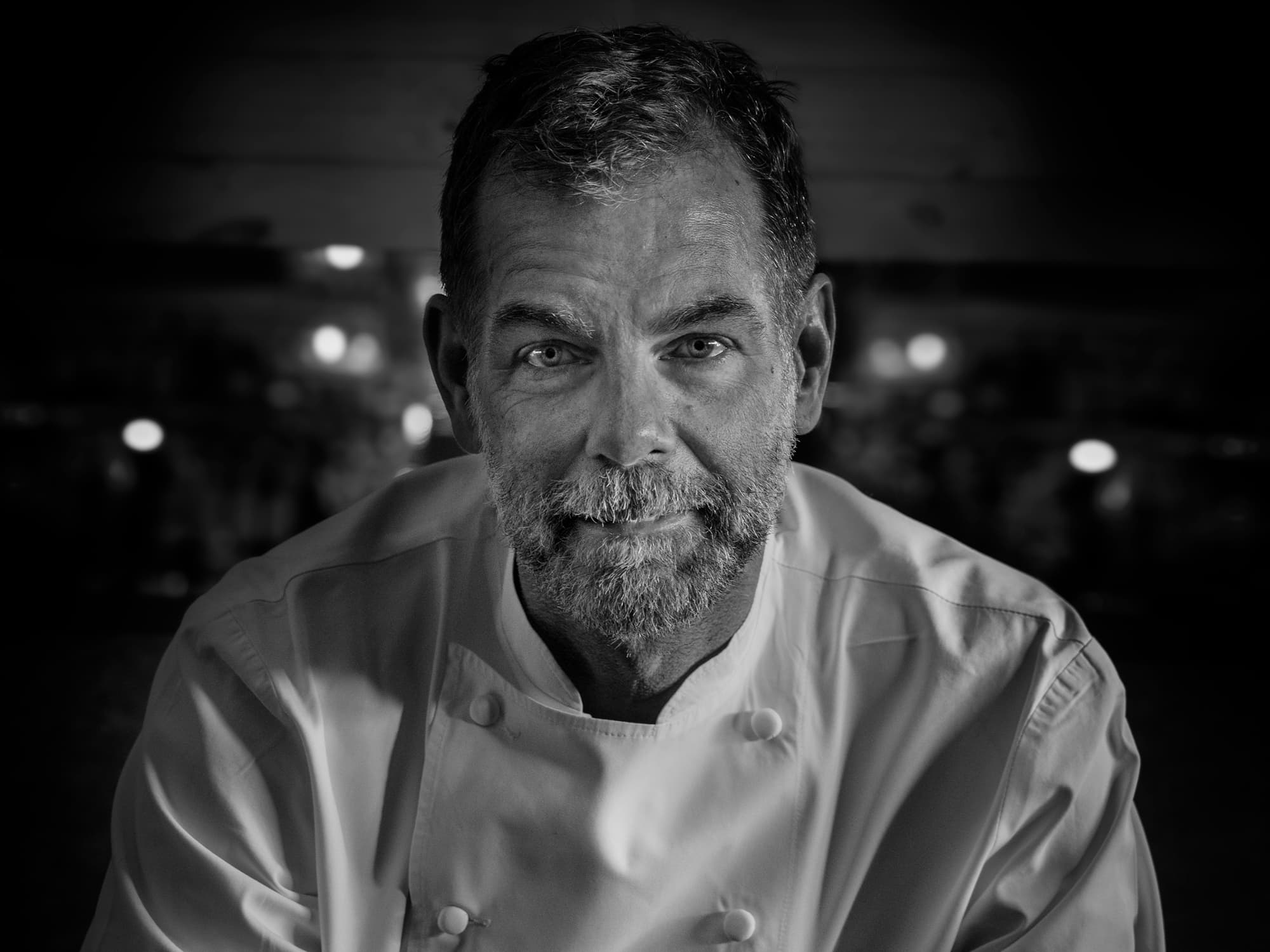
Chef Barclay Dodge on building Bosq one rung at a time, one service at a time, and one season at a time.
Interview by Bryan Welker and Stefan le Roux | For The Aspen Times
Chef Barclay Dodge came to Aspen as a 14-year-old outsider with an accent, and over time he found both his home and his calling. Working his way through dish pits, back lines, and long nights in the heyday of Aspen in the ’80s, he realized food wasn’t just a job—it was going to be his life.
What began as a teenager’s way to earn a summer paycheck has evolved into Bosq—the valley’s only Michelin-starred restaurant. Nearly four decades into his career, he speaks less about accolades and more about steadiness—about keeping a team intact, refining a tasting menu that mirrors the woods and farms around him, and building a business that can outlast the volatility of the town he grew up in.
Bryan: What’s your Aspen story? How’d you get here?
Barclay:
I moved here at 14 from Alabama—best move I ever made, and the hardest. I came in as a freshman with an accent, so I had to get past the ‘fixing to do something’ and ‘y’all’.
But after the first semester, it was all good, and I fell in love with this place. At the end of the day it’s a small town like any other in many ways.
Bryan: And then after high school?
Barclay:
Like I said, it’s a small town and if you don’t get out you might end up with a small town mentality, so I took off. I went back down south for one semester—Mississippi State, I hated it. I came back for Christmas break and never went back.
But I found my calling early with food. When you live in a town like this, your summertime jobs are either pounding nails for somebody’s dad in construction, or bussing tables and washing dishes.
My first job was washing dishes at Calypso. I lasted a few weeks. My mom came back from vacation, took one look at the scene—downtown Aspen in the ’80s, cocaine everywhere—and said, “You’re not working there.” I was 16.
Then it got real. I worked at Andiamo, spent a long time at Mezzaluna, followed by the Mine Company, the Paragon, and Bonnie’s. By the time I was 20, I knew that this was what I wanted to do.
I dropped out of college—I was a terrible student—and moved to San Francisco for culinary school. I loved it. It was the perfect city to learn in. The whole city felt like a culinary school. And the rest is history, as they say.
Bryan: What’s your biggest challenge right now?
Barclay:
Labor. Always. We’re really good with employees. I’ve had the same core team for around a decade. I take care of my team—that’s my biggest motto. Take care of the team.
But you’re always dealing with 15 or 20% of your team turning over. You need those positions filled, and it’s hard—especially in a business that requires professionalism.
And labor is expensive, too. You get what you pay for.
Bryan: How did COVID change things for you?
Barclay:
COVID created a major shift. It changed the fabric of our community. It was like 20 years of change crammed into three or four years. We’re still dealing with it.
For me, pre-COVID, I knew 25–30% of people on the book every night. When COVID hit, I didn’t know anybody. Now I think we’re starting to see a little comeback—people who stayed are developing a home here, we’re getting to know them, and the older crowd is coming back.
Bryan: What did the Michelin Star do for you and Bosq?
Barclay:
I don’t think I’ll ever see a year like the one after getting the Michelin Star. The numbers at first were out of control, but the nice thing is that it leveled the seasons out a little.
This town is still wildly up and down. In the summer, you’re not really busy until Food & Wine, and then July 4th is the real kickoff. But then, around August 15th, it drops, and when kids go back to school, it really drops. Winter’s the same story.
At least the Michelin Star stabilized some of that.
Bryan: You also made a big business-model shift during COVID, right?
Barclay:
Yeah. COVID changed our business model. We became a 12-seat restaurant because of social distancing requirements and how small we were, so we went from à la carte to tasting menu.
It’s what we wanted as a kitchen too. Not because it’s easier, but because it’s our craft. That’s us cooking at the highest and most creative level.
With a tasting menu, you can focus so much more on the food. So much effort goes into each dish—the technique, the creation, the execution.
After that first winter, I thought, “Okay guys, we’ll go back to à la carte for summer.” The team said, “No chef—don’t do it. Let’s keep doing the tasting menu.”
We never looked back.
Bryan: What advice would you give someone trying to start out—washing dishes, bussing tables, thinking this might be their career?
Barclay:
Don’t skip rungs on the ladder and don’t look too far ahead. I see so many cooks want to become a sous chef because it pays a little more, and sounds better when they should be cooking for another two or three years.
It’s harder to go back. If you go through each step, you build the repertoire of knowledge you need when it’s time to execute and get the most out of your team.
And it’s a long career, and it’s not a very well-paying career either. You starve as a chef. You grind. I’m 57 and I’m still working more hours than my employees. I got to work at 8:30am today and I’ll be there till close. That’s the norm. That’s my lifestyle.
Also—teamwork matters. I don’t do this by myself. I catered for a couple years between jobs and it sucked. You’re by yourself.
I love it to death.
Bryan: What’s your favorite part of your job right now?
Barclay:
The team dynamic. My favorite hour of the day is 5:15, fifteen minutes before we open. Everybody’s in the thick of it, and it’d be so much easier to walk out the back door and never come back, but that’s the best time. It’s dynamic.
Creativity is another thing, but I look at myself more as a craftsman than an artist. For sure, we come up with things whimsically and on the fly but it all goes back to the craft. Without the craft, I wouldn’t be executing any of those ideas.
Bryan: If someone’s in town for three nights and can only eat at two places—why should one of them be Bosq?
Barclay:
We’re presenting something unique to Aspen.
We’re out in the woods foraging three days a week, even in winter we get out there. I’d say 85% of our menu is from right here—farms up and down the valley and over in Paonia.
So we’re giving you a real feel of time and place. We’re really into what we do. We’re not messing around.
Bryan: How long did it take for you to feel established at Bosq?
Barclay:
My first restaurant, Mogador, didn’t make it. It closed after four and a half years.
We hit the five-year mark at Bosq and that’s when we really went into the black. They say it takes five years. COVID helped and changed our model. The star helped. Now we’re healthy—and it’s nice, because I want to take care of my employees, and I want to take care of my family.
Aspen has always had its cycles—booms, headlines, accolades. But beneath that rhythm are people who stay, who build, and who keep refining their craft.
Barclay Dodge is one of them. The Michelin Star may have elevated Bosq’s profile, yet what defines him is steadier than that: the craft he has practiced since he was a teenager, the team he has built around him, and the decision to root his work in the small town he calls home.
Bryan Welker lives and breathes business and marketing in the Roaring Fork Valley and beyond. He is President, Co-founder, and CRO of WDR Aspen, a boutique marketing agency that develops tailored marketing solutions. Who should we interview next? Reach out and let us know bryan@wdraspen.com