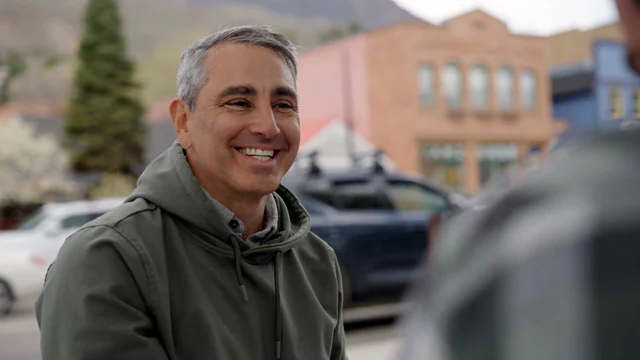
Alex Kelloff on Aspen’s identity crisis, the disappearing middle class, and what communities owe the next generation.
Interview by Bryan Welker and Stefan le Roux | For The Aspen Times
There’s an old version of Aspen that still lives vividly in the minds of the people who were here before luxury storefronts replaced local shops, and before housing became a financial obstacle course. It was never cheap, but there was once a version of the town where artists, carpenters, ski bums, celebrities, bartenders, and business owners all collided in the same rooms.
For Alex Kelloff, whose Colorado roots stretch back more than a century, that version of Aspen isn’t nostalgia. It’s the version he grew up around—and the version he believes communities across the Roaring Fork Valley are in danger of losing.
Bryan: Tell us a little about your connection to Aspen.
Alex: My roots in this district go back to roughly 1893. My family came to southern Colorado for coal mining jobs, and eventually my grandfather started Kelloff’s Food Markets in the San Luis Valley during the Great Depression.
My family were all small business people—grocery stores, furniture stores, general stores. On my mom’s side, my grandfather moved to Carbondale in the early ’60s as a carpenter because he saw what these mountain communities were becoming.
My parents got married in Aspen 58 years ago. I learned to ski here in the ’70s, and Aspen always felt like home to me.
Bryan: You spent a fair time away from the valley. What was it about Aspen that pulled you back?
Alex: The outdoor lifestyle. Skiing, biking, camping, hunting—that was always the dream. To eventually live in a place where that lifestyle wasn’t something you visited, but something you lived every day.
Bryan: Aspen has never been an easy place to make it, but it feels like there has been a shift. What happened?
Alex: I think COVID-19 and the government response to COVID-19 accelerated a lot of what we’re now seeing. The amount of money that flooded into the economy protected asset owners, and people with money suddenly had flexibility to leave cities and move to places like Aspen or Telluride. That drove up housing prices, rental prices, taxes—everything.
And then you get the downstream effect. Restaurants, local businesses, workers, artists—they all get squeezed because the economics stop making sense.
But the bigger issue for me is what happens culturally when that middle layer disappears. My grandfather used to sit at the Red Onion with John Denver, Hunter S. Thompson, tradespeople, wealthy visitors—everybody mixed together. There was a real vibrancy that came from that collision of people.
We’ve lost some of that. And the irony is that even the billionaires eventually realize, “This isn’t very fun anymore. It’s just a bunch of billionaires hanging out.”
Bryan: I’ve lived here almost 30 years now, and I do feel that. The town goes dark earlier. There are fewer weird characters. Fewer artists. Fewer people scraping by because they love the place enough to sacrifice for it.
Alex: Exactly. Aspen has always been hard. Nobody’s arguing it was easy. But there’s a difference between a place that demands sacrifice and a place that becomes inaccessible altogether.
If only one category of person can realistically participate in a community, eventually you lose the diversity of thought and personality that made the place special to begin with.
Bryan: One of the hardest conversations in Aspen is around housing. Everybody agrees it’s a problem, but nobody fully agrees on the solution. What do you think communities owe to the next generation trying to build lives here?
Alex: We owe them investment in the community itself. Housing is part of that, but so is healthcare, infrastructure, transportation, and public lands.
We also desperately need more people entering the trades—builders, electricians, plumbers, carpenters—and we need to make it easier for small businesses to grow without burying them in regulations that larger corporations can easily absorb.
Healthy communities create healthy local economies. That’s an investment, not a handout.
Bryan: You’ve spent decades in business before running for office. How much does that shape your perspective?
Alex: Completely. I helped found Armada Skis, and I’ve spent more than 30 years building businesses in telecommunications and infrastructure.
When you’ve actually built things, you understand how policy affects people practically, not theoretically. You understand what uncertainty does to business owners.
That’s one of the reasons I decided to run.
Bryan: What are the biggest concerns you’re hearing from people across the district right now?
Alex: Cost of living is number one everywhere—housing, healthcare, groceries, gas, transportation.
The other major issue is protecting public lands and water. Outdoor recreation and agriculture rely on those lands, and so do the communities built around them.
Beyond that, people simply want the ability to build something. They want to raise families where they work and feel like there’s still a pathway to stability.
Bryan: Last question. In the spirit of this column, what do you think Colorado owes the next generation of entrepreneurs and small business owners?
Alex: I think we owe them stewardship. Stewardship of public lands, stewardship of communities, stewardship of infrastructure, stewardship of opportunity.
My family has been in this district for over 130 years. Over that time, communities invested in themselves. Somewhere along the way, we stopped thinking long-term.
The next generation deserves communities that still function. Places where people can build lives, not just visit them. Places where businesses can grow. Places where the culture still belongs to the people who live there.
And I think that’s worth fighting for.
Aspen has always demanded sacrifice from the people who choose to live here. But for decades, the tradeoff felt worth it because the town still belonged to a wide spectrum of people.
The concerns expressed in this conversation are difficult to ignore: What happens when the people who build the culture of a place can no longer afford to participate in it?
That question is no longer abstract in Aspen. It may define the town’s future.
Bryan Welker lives and breathes business and marketing in the Roaring Fork Valley and beyond. He is President, Co-founder, and CRO of WDR Aspen, a boutique marketing agency that develops tailored marketing solutions. Who should we interview next? Reach out and let us know bryan@wdraspen.com